
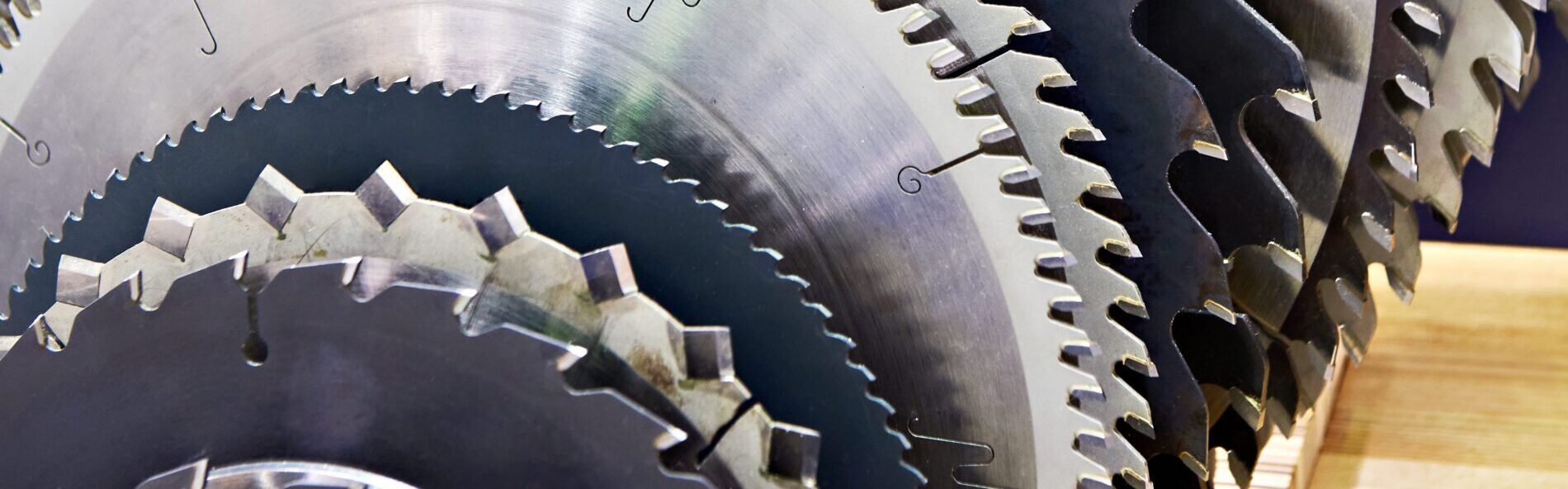
Anyone who has spent time on the shop floor knows that the wrong blade choice costs far more than the blade itself. Time lost, poor cut quality, broken teeth, and machines running harder than they need to all follow from a poor blade choice.
Whether you are cutting mild steel, stainless steel, exotic steel, aluminium profiles or structural sections, the blade you choose is one of the most consequential decisions in your cutting setup. This guide breaks it down clearly, covering blade types, materials, tooth geometry, and the specific questions you should be asking before you buy.
First: What Is A Circular Saw Blade for Metal Cutting?
A circular saw blade for metal cutting is a toothed disc designed to cut ferrous and non-ferrous materials with precision and control. Unlike abrasive chop saw discs, which grind through material and generate significant heat, metal cutting circular saw blades (often called cold saw blades) use a slicing action that keeps the workpiece and blade cool during the cut.
This is important. Heat is the enemy of both dimensional accuracy and blade life. A cold saw blade working correctly should leave a cut that you can touch within seconds of the blade stopping.
The two primary blade types you will encounter in industrial metal cutting are:
• HSS (High Speed Steel) circular saw blades
• TCT (Tungsten Carbide Tipped) circular saw blades
Each has a distinct role. Choosing between them is the first decision you need to make.
HSS vs TCT Circular Saw Blades: Which Do You Need?
Here is a direct comparison to help you make the call quickly:
| HSS Saw Blades | TCT Saw Blade | |
|---|---|---|
| Best for | Best for Solid steel bar, structural sections, high-volume production Non-ferrous metals, aluminium, thin-walled profiles, stainless | Non-ferrous metals, aluminium, thin-walled profiles, stainless |
| Cutting action | Aggressive, high feed rate | Precise, low noise, very clean finish |
| Blade life | Blade life Shorter per blade, but can be resharpened Longer per blade, carbide holds edge well | Longer per blade, carbide holds edge well |
| Cost | Lower upfront cost | Higher upfront, lower cost per cut over time |
| Resharpening | Yes, extends blade life significantly | Yes, but requires specialist equipment |
| Typical RPM | 20–100 RPM (slow speed cold saw) | Variable, check manufacturer specification |
A general rule worth keeping in mind: if you are cutting solid steel in volume, you almost certainly want an HSS blade on a cold saw. If you are cutting aluminium extrusions, PVC profiles or thin-walled tubes, a TCT blade is likely the better tool for the job.
Understanding Tooth Count and Tooth Geometry
Once you have settled on blade material, tooth configuration is the next variable, and it matters more than most people realise.
Tooth Count (TPI)
Tooth count is not a case of more-is-better. It is about matching the blade to the cross-section you are cutting.
• High tooth count: cleaner finish, better for thin material and tube
• Low tooth count: more aggressive cut, better for thick, solid sections
• Too many teeth on thick material: chips cannot clear fast enough, heat builds, blade wears prematurely
• Too few teeth on thin material: blade grabs, rough finish, risk of material movement
If in doubt, a blade with a mid-range tooth count is more forgiving across different sections, though dedicated blades for specific applications will always outperform a compromise choice.
Tooth Geometry: Set, Pitch and Rake Angle
These are the finer details that most buyers overlook until something goes wrong.
Rake angle: Positive rake cuts aggressively and is suited to softer metals like aluminium. Neutral or negative rake is used on harder materials such as steel and stainless steel to reduce the risk of tooth chipping.
Pitch: Variable pitch blades reduce harmonic vibration during the cut. This is particularly useful when cutting tube or profiles where the blade is intermittently engaged with the material.
Tooth set: The degree to which teeth are offset from the blade body. Wider set produces a wider kerf, which is good for chip clearance in deep cuts. Narrow set gives a tighter, cleaner kerf on shallow cuts.
What Material Are You Cutting? Start Here.
This is the single most useful question to ask before selecting a blade. The material dictates almost everything else.
Mild Steel and Structural Steel
This is the heartland of the HSS cold saw blade. Mild steel responds well to high-speed steel at low RPM with cutting fluid. For solid bar and structural sections in production environments, this is typically the most cost-effective setup when you factor in resharpening cycles.
A metal cutting cold saw running an HSS blade at the correct feed rate should produce a clean, burr-free cut with a finish that often needs no secondary processing.
Stainless Steel
Stainless is harder on tooling than mild steel and work-hardens quickly if the cut stalls or the blade rubs rather than cuts. This makes blade selection and setup more critical. You need a blade with the correct rake angle for stainless, sufficient cutting fluid, and consistent feed pressure. Running a blade too slowly through stainless steel is often worse than running it at the correct speed. Hesitation causes work hardening, which rapidly dulls the blade.
Aluminium and Non-Ferrous Metals
Aluminium is soft but presents different challenges. It is sticky, tends to load up the blade, and requires good chip clearance. TCT blades with a positive rake angle and wide gullets are the standard choice here. Cutting without fluid is possible in some applications, but flood coolant dramatically extends blade life and improves finish quality on aluminium.
For the window and door fabrication industry, cutting aluminium profiles, blade selection is particularly important given the thin wall thicknesses and tight dimensional tolerances involved.
Tube and Hollow Sections
Tube presents a specific challenge: the blade enters and exits the cut with each rotation, meaning engagement is intermittent. Variable pitch blades handle this better than uniform pitch equivalents. Wall thickness determines tooth count, as thin-walled tube needs more teeth in contact with the material at any given moment.
Blade Diameter and Saw Compatibility
This one catches people out. Blade diameter must match the saw specification, but the relationship between blade diameter and cutting capacity is not always straightforward.
A larger diameter blade does not simply mean a larger cutting capacity. The arbor size, blade thickness, and RPM rating all have to be compatible with the machine. Running a blade outside its rated speed range is a safety risk, not just a performance issue.
| Key Compatibility Checks | Why It Matters |
|---|---|
| Blade diameter matches saw specification | Ensures correct guard clearance and cutting capacity |
| Arbor bore matches machine spindle | Incorrect bore creates runout and vibration |
| Blade RPM rating meets or exceeds machine speed | Safety critical. Blades have maximum rated speeds |
| Blade thickness suits the application | Thicker blades are more stable on solid sections; thinner blades reduce kerf loss |
Resharpening: The Part Most People Skip
One of the most overlooked aspects of circular saw blade economics is saw blade resharpening. An HSS blade that is allowed to run to failure costs more per cut than one that is resharpened at the right point in its life cycle.
The signs that a blade needs resharpening are usually obvious if you know what to look for:
- Increased cutting noise or chatter
- The machine working noticeably harder than usual
- Burring on the cut face that was not there before
- The cut taking longer than expected at normal feed pressure
At Addison Saws, blade resharpening is carried out through our dedicated service, a dedicated sharpening operation that restores blades to specification rather than simply touching up the edge. A properly resharpened blade performs comparably to a new blade and significantly reduces the cost per cut over the life of the tooling.
Do not wait until a blade is fully blunt. By that point, you have already lost teeth, and the blade may have been running in a degraded state that has affected the quality of your recent cuts.
Keep It Right and Keep It Running
Choosing the right circular saw blade for metal cutting is not complicated once you have the right framework. Start with the material, match the blade type and geometry to that material, check compatibility with your machine, and build resharpening into your tooling maintenance cycle.
Get those basics right, and you will cut more accurately, more consistently, and at a lower cost per cut than you are probably achieving now.
Addison Saws stocks HSS circular saw blades, TCT saw blades, and a full range of cutting fluids and lubricants suitable for industrial metal cutting applications. If you need help specifying the right blade for your machine and material, call our team on 01384 264950 or use the contact form. We have been helping UK manufacturers cut metal correctly since 1956.